
By Sylvie Roman – CVX in Switzerland (original in French)
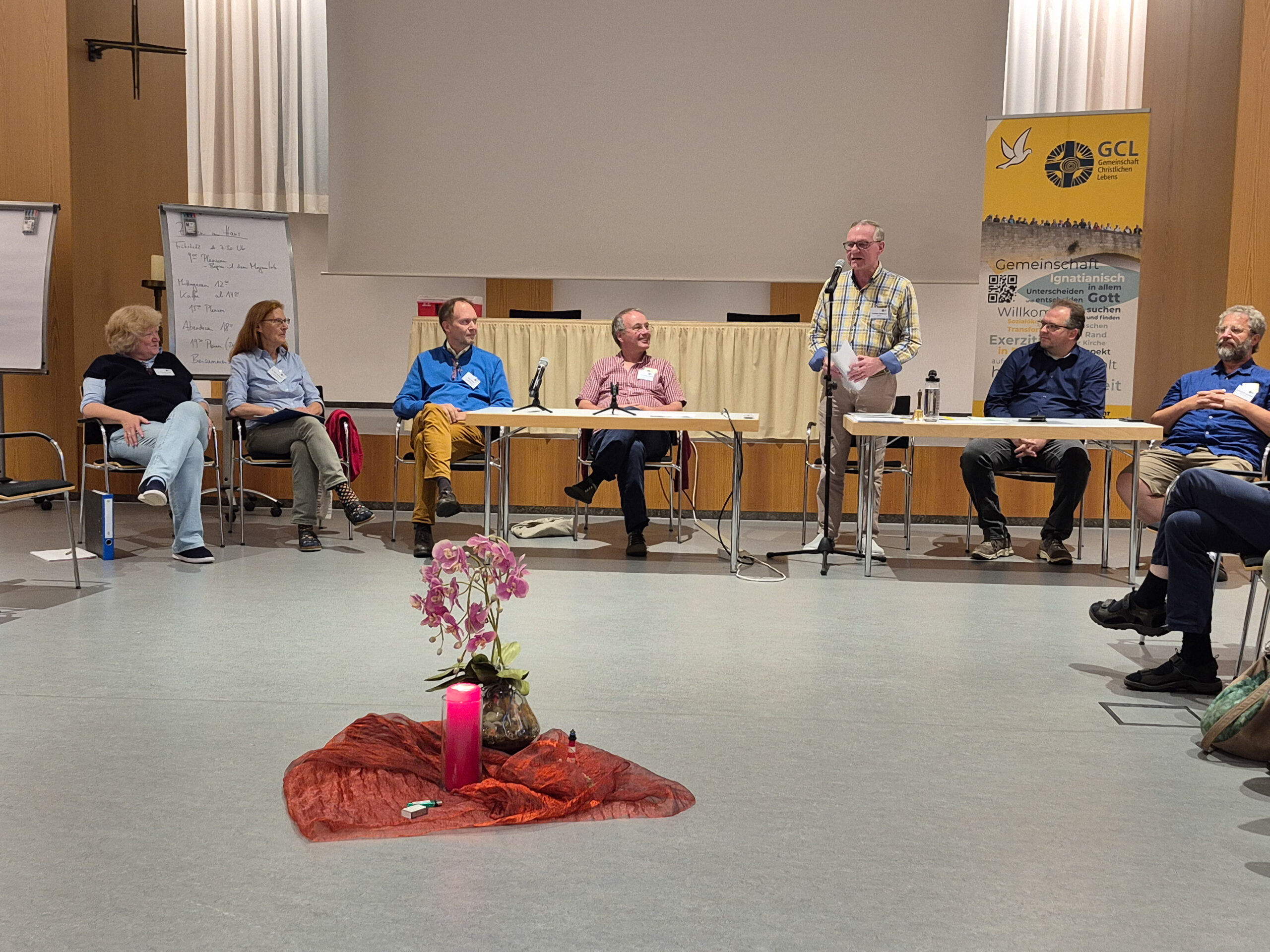
“Consolation” and “desolation”: these two words are at the heart of our CLC meetings. “Consolation” and “desolation”: these two words are at the heart of our CLC meetings. Such were both the testimony and the invitation of Father Jean-Luc Fabre, SJ, at the 2025 coordination meeting of CLC in Switzerland.
A training as a igniting element
Father Jean-Luc shared with us how the training of just one person was enough to transform the local community he accompanies. Let us note that he knows CLC well, having served as ecclesiastical assistant for France—a role carried in Switzerland by Sr. Marie-Brigitte Seeholzer.
Following the training of this one person, the focus of the meetings shifted, allowing the local community to take another step on its path of growth. Previously, although the team already centered its review on the past month—looking for movements of life or, on the contrary, obstacles—this review was still mainly based on facts, actions, or situations. In addition, the team felt the need to orient the review around a particular theme. Little by little, they took an additional step: they learned to focus on the consolations and desolations experienced, without any other instruction for the review.
Listening to the motions
Identifying consolations and desolations means focusing on what dwells within us at a deep level. The motions—our inner movements—speak to us about our being and our relationship with God. They are both linked to what we live in a situation (“linked to what we live on the periphery of our being in the situation,” says Father Jean-Luc) but also independent of it, insofar as consolation can be present in any situation, whether it is pleasant or difficult. “Consolation and desolation indicate the profound stakes of existence,” he adds. Observing these motions helps us find our bearings on our path of spiritual growth and of deepening our relationship with God.
Three types of consolation
Let us then focus on consolation. It is not always easy to recognize; it comes in several forms. Father Jean-Luc describes three types, referring to points 316 and 317 of the Spiritual Exercises of St. Ignatius (the third and fourth rules). He also mentions an article by Adrien Demoustier, SJ, originally published in Christus HS 170 (https://www.revue-christus.com/article/reconnaitre-la-consolation/5332 )
Enthusiastic consolation: This is the one we often think of, the easiest to grasp, where we feel inflamed or filled with a lasting joy.
Painful consolation: This consolation appears even when one is in a difficult or painful situation. Consider the example of tears—tears brought on by pain yet also bringing consolation. In crying, one recognizes the situation, becomes partly freed from it, and emerges transformed. This form of consolation goes beyond the situation lived. It creates distance between the situation and the identity of the person: it is like setting oneself in motion—accepting the situation and stepping out of it to realize that, whatever happens, our identity remains. This consolation leads to a deepening of love, hope, and faith.
Consolation of availability: Every consolation produces something, but this one is harder to detect even though it is the most common. It is characterized by a stable state, not by a feeling that comes and goes. It can be recognized by a sense of well-being or life-energy that makes one available to serve within the situation.
From doing to being
Father Jean-Luc has observed that sharing focused on consolations and desolations leads to a different kind of sharing and listening. Instead of talking about ourselves, we listen more attentively to the Spirit. And when listening to others, we also pay attention to consolation and desolation—that is, to the Spirit.
With this type of review and sharing, being becomes central. We focus on the Christian identity of the person, on the being that remains regardless of the situation. The person acquires a certain freedom, independent of what they are going through. They then choose principles oriented toward growth.
Magis
We are called to a “more,” to an “abundant life,” to a “greater” (magis), understood as a greater quality rather than quantity. We are called to grow in love. Of course, doing and being remain linked; the point is not to separate them, but to maintain a tension between them that keeps us moving. It is precisely in the concreteness of our situations that we are called. Father Jean-Luc concludes by recalling this phrase of Ignatius: ”The human person is created to praise, reverence, and serve God our Lord, and by doing so, to save his soul.” May this sentence from the “Principle and Foundation” guide us in our next CLC meetings.
Thanks to Father Jean-Luc, who agreed to review this article.
Offering Prayer
During his visit to Switzerland, Father Jean-Luc Fabre also had the opportunity—as national director for France of the Pope’s Worldwide Prayer Network—to speak about prayer at the Sainte-Ursule Center in Fribourg. He emphasized the offering prayer, meaning an invitation to give oneself to Christ through a double movement: receiving oneself from Him and giving oneself, in an impulse of offering and availability, day after day, rediscovering the priestly dimension of our being. The morning offering and the evening review, with attention to our daily consolations/desolations: this is an Ignatian program offered to all. Father Jean-Luc also mentioned the “Click to Pray” app ( https://clicktopray.org/) , which can help us in this practice.