By Ivette Cáceres CLC in Dominican Republic. Member of the Global Formation Team
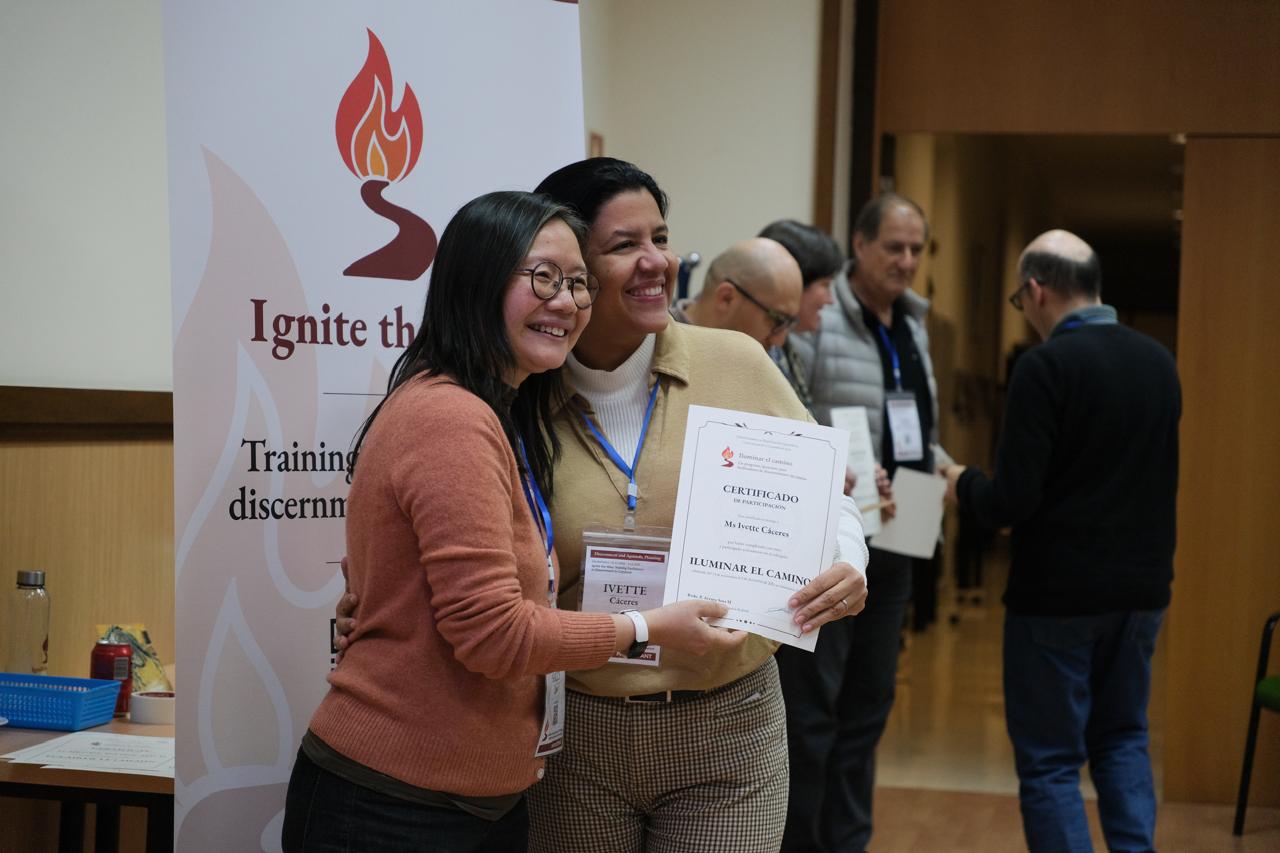
From the email I received from World President Chris Micallef, I felt that this invitation was not just about participating in a workshop, but a call from the Spirit. The letter and message of Father General, Arturo Sosa, at the beginning of the meeting, profoundly confirmed this internal movement. Fr Sosa’s invitation to become Church, to open ourselves to listening to the Spirit through communal discernment, and to recognize the need for a plan and a new narrative, as liberating as that of Jesus – these placed me before a new mission: to contribute to the building of a truly synodal Church.
From day one of the meeting, one of the themes that resonated with me the most was vulnerability. With the first conferences I understood that communal discernment invites us to recognize that we are fragile, but also to discover that God himself makes himself vulnerable and needs us for the work of salvation. Salvation is not a perfect or linear process; it is built between successes and failures, and God speaks precisely in the cracks, in the wounds, in the humanity of Jesus.
Linked to this, it was very illuminating to understand the concept and the need for a redemptive power. Just as God’s power is not domineering or overpowering- it is a power that draws near, touches wounds, and transforms from within synodality leads us to the crucified Jesus and changes the way we understand power within the Church: not as control, but as service that heals and redeems.
Another fundamental learning was the passage from “I” to “we”. Communal discernment is only possible when each person has previously walked a path of personal discernment, the same thing that happened with St. Ignatius and the founding fathers. It is not something immediate or automatic; it is a process that demands conversion, humility, and deep listening. God communicates through the gifts he offers to each person, and only from this equality in speaking and listening can a true communal discernment emerge.
Conclusion
Finally, this experience confirmed in me that synodality is not just a structure or a methodology, but a spirituality. Creating a synodal culture implies caring for relationships, exchanging gifts, charisms and vocations, and entering into a profoundly divine dimension, where prayer and the action of the Spirit are at the heart of the whole process. Our task is to create the context so that people can encounter God and be guided by Him. I leave Ignite the Way with deep gratitude and with the commitment to continue promoting communal discernment as a way to make Church, trusting that it is the Spirit who guides and sustains this process.
For more information about the initiative: https://www.jesuits.global/2025/11/24/ignite-the-way-the-society-of-jesus-taking-synodality-forward/